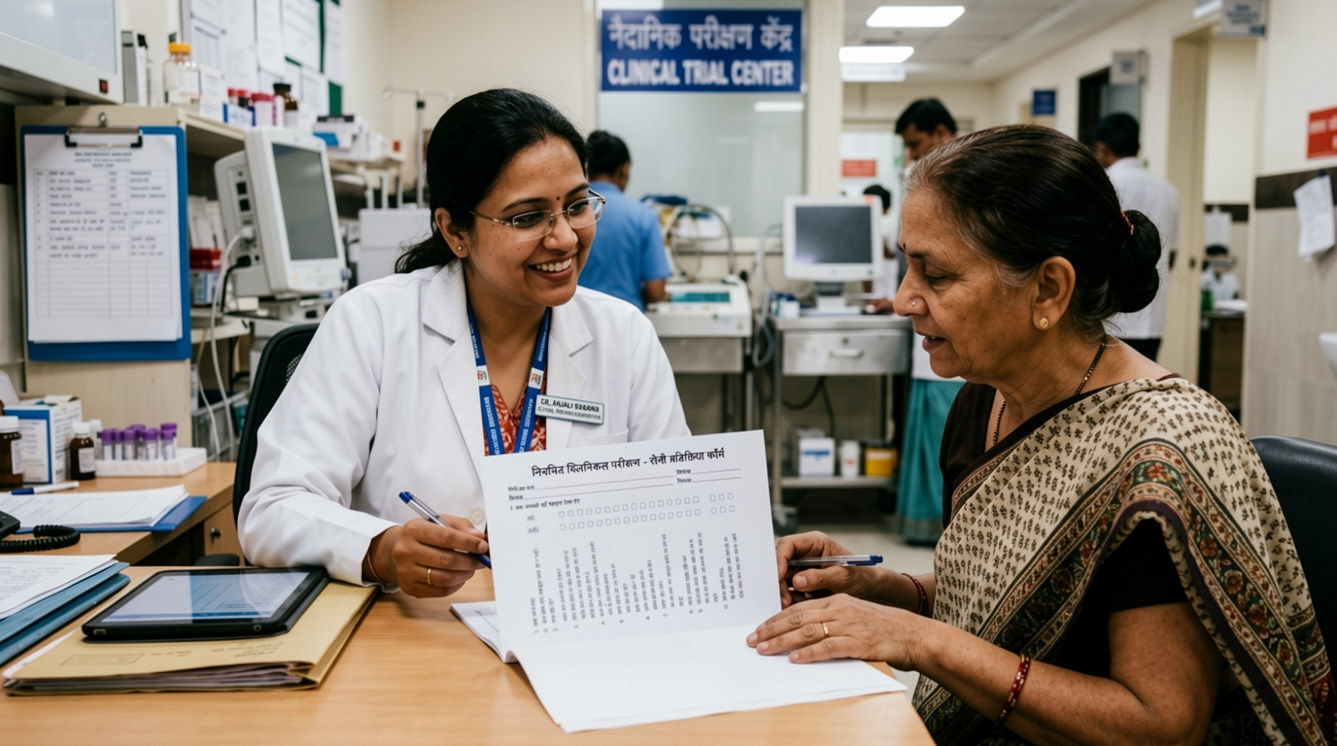
Over the years that I've been running around the clinical research circuit, I've heard countless references to raters verbally rephrasing COA items, or parts of items, to clarify their meaning for patients.
It is not a myth. Most of us know it happens. What we do not know is how often it happens, because it is not formally measured. We also do not know, in any concrete way, what effect it has on trial data. It may introduce noise. It may also, in some cases, reduce noise by rescuing an otherwise unusable translation. Either way, once an already approved wording has to be orally reconstructed at the site level, the consistency in translation is outside of the controlled workflow.
As the translation industry adage goes, a translation is only as good as its translator. In the context of clinical trials, a translation is also only as good as the assumptions built into the scope of work, the register chosen for the target population, the extent of localization permitted by the sponsor's internal policies, and the feedback loop between the teams producing the text and the teams using it with patients.
Hindi in India's Multilingual Context
Hindi is spoken across northern and central India by about 528 million people. But it is not a single shared language. The census category includes a broad grouping of Hindi varieties and related regional speech forms, alongside formal Standard Hindi. A speaker counted under "Hindi" may not speak the same kind of Hindi that appears in a translated PRO, consent form, or patient diary.
Another Western misconception is that Hindi is India's national language. India does not have a national language; Hindi is one of India's official languages, alongside English and 20 other languages. For decades, in places other than the North, there has been a strong resistance to adopting Hindi as a national language.
Tamil, Telugu, Kannada, Malayalam, and other southern Indian languages are distinctly different. They use different writing systems, follow different grammatical structures, and belong to different linguistic traditions. For speakers of those languages, Hindi is not a neutral bridge.
Hindi: A Dialectal Spectrum
Standard Hindi is highly Sanskritized. It uses many words derived from Sanskrit, giving it a polished, academic quality that is far away from everyday speech. Modern spoken Hindi has a broad dialectal spectrum, and historically India has had large differences in educational access.
Standard Hindi is appropriate for government documents, legal texts, school curricula, media, and official communication. But its formal register can create comprehension problems for people with limited formal education or limited exposure to institutional Hindi — especially older adults and women from communities where educational access has historically been restricted.
Which Hindi, Then?
In a conversation with Dr. Vikas Mohan Sharma, a long-time clinical trialist currently serving as Chief Medical Officer at Neuraxpharm, I asked for his advice on how to handle Hindi dialects. His answer: produce a common Hindi translation, not the formal kind. Then, have it reviewed by someone from that region. That someone should be a clinician, not a translator.
The "common Hindi translation" refers to a lower register — so that the language is not wrong. Medical translators can produce a clean, fluent and terminologically correct translation, but they do not have equal depth of experience in the communication style between doctors and patients, and may miss important nuances, phrases doctors use to clarify questions, and euphemisms doctors use to neutralize stigmatized concepts.
What About the Clinicians?
India's multilingual environment is complex. English is widely used in higher education, research, legal and regulatory communication, while Hindi, regional languages and local varieties have different public and everyday roles. As Dr. Sharma put it: "Doctors in India are educated in English. Fluency in English is generally not a problem, especially by the time they qualify to participate in trials."
This means clinician-only documents can be provided in English. But many clinician-administered assessments include interview guides, scripted prompts and probes. When the clinician has to ask the patient a scripted question, those must be translated and adapted to the local spoken variety of Hindi.
We maintain project histories, record revisions and reasons for them, along with translation memories. The maintenance of the translated content lifecycle reduces redundant translation work, the burden on sites to verbally modify, and the noise in data sets that inconsistent verbal modifications can produce.